
For decades, companies planned offices around one simple idea: every employee needs a permanent desk.
That model worked when people came to the office five days a week. But today, hybrid work has changed everything. Many companies now pay rent, heating, electricity, cleaning, maintenance, and infrastructure costs for desks that stay empty most of the week.
The problem is not only the office size. The real problem is static furniture.
A traditional desk occupies the same amount of space whether someone is working there or not. It cannot adapt to occupancy. It cannot disappear when unused. It cannot serve another purpose during the day. So even when only 40% of employees are present, companies still pay for 100% of the workspace.

Office furniture looks like a one-time purchase, but in reality it creates long-term operating costs.
Every fixed desk needs:
When the desk is unused, all these costs continue.
This is why traditional office layouts become expensive in hybrid environments. Companies are no longer only buying desks. They are paying monthly for the space those desks permanently occupy.
Hybrid work is flexible, but most offices are still built with fixed infrastructure.
That mismatch creates waste.
A flexible office should allow companies to use space based on real occupancy, not old assumptions. If fewer people are in the office on certain days, the space should be usable for meetings, training, presentations, collaboration, or simply reduced office footprint.
Static desks block that flexibility.
Flexible workstations solve this by giving companies the ability to use the desk when needed and fold it away when it is not needed.
Height-adjustable desks improve ergonomics, but most of them are still static.
They help the user sit and stand, but they do not solve the bigger office problem: space.
A normal standing desk still occupies the same floor area all day. It still needs a fixed place. It still prevents the room from being used differently.
The next step is not just ergonomic furniture. It is adaptive furniture.
FlexiSmart is designed for modern hybrid offices, home offices, schools, universities, and flexible workspaces.
It combines:
When needed, it works as a full workstation. When not needed, it folds away and releases the occupied space for other applications.
This allows companies to rethink office planning around actual usage instead of fixed desk count.
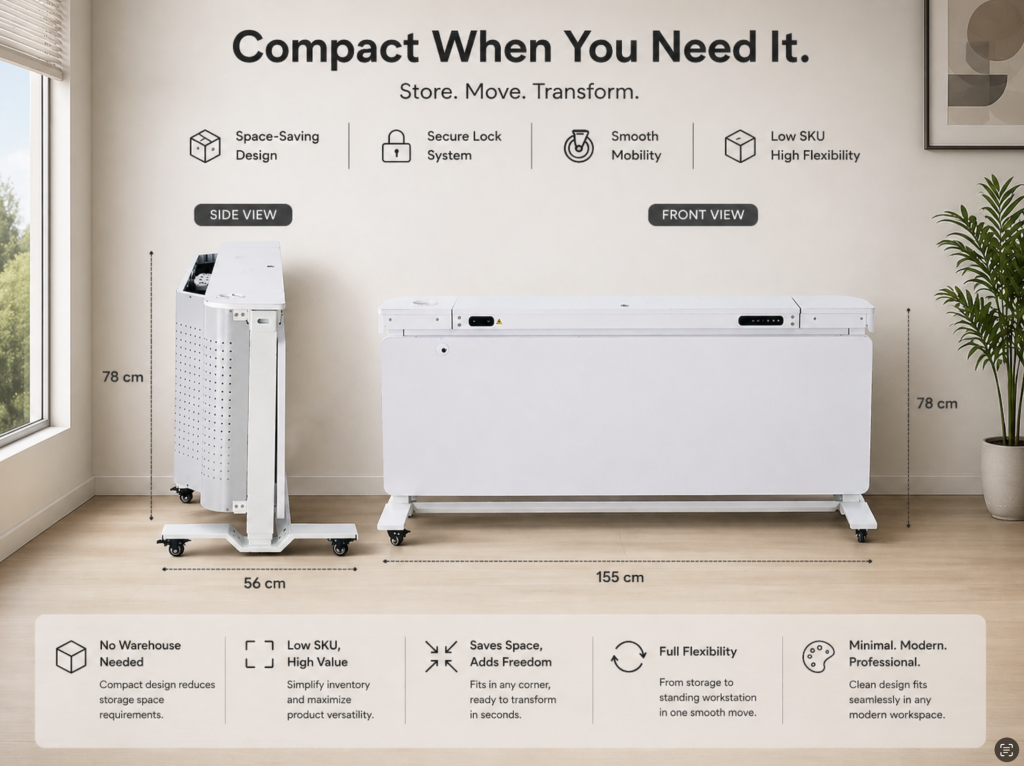
In many hybrid offices, companies pay for desks that are unused most of the time. With flexible workstations, companies can plan based on occupancy rate, not total employee count.
Depending on office layout and usage model, this can help reduce infrastructure and operating costs by up to 70%.
The saving does not come from cheaper furniture. It comes from using less permanent space, reducing wasted infrastructure, and making each square meter work harder.
The companies that win in the next office generation will not be the ones with the most desks. They will be the ones that use their space intelligently.
Traditional desks were built for fixed offices.
FlexiSmart is built for flexible work.
If your office is hybrid, your furniture should be hybrid too.
Want to see how FlexiSmart works?

9 Gedanken zu „Why Static Office Desks Are Quietly Eating Your Budget?“
Wish you happiness
yahoo,im go
Every day is a new beginning
Great content! Keep up the good work!
Good a blog toper
Im 4466,yahoo
Here you are
Great post,Thanks for sharing
Hi~(* ̄▽ ̄*)